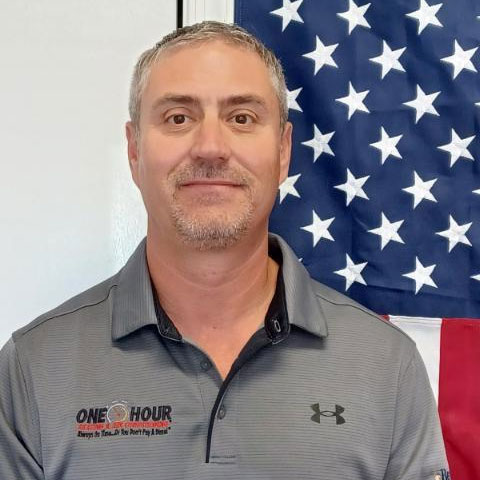
Ron has been running franchises since 2002. Today he operates Benjamin Franklin Plumbing and One Hour Heating and Air out of Ocean City, Maryland — two brands under one roof, run as separate companies. The business is 85% residential, 15% light commercial. No new construction.
He's competing in a market with seven private-equity-backed players within driving distance. He can't outspend them, so he's focused on local neighborhoods, postcards, home shows, tech-generated leads, and building a team that thinks like owners.
“I had two goals. Take care of the customer to the best of our ability, and never have anybody ask me for a raise ever again. I believe both got accomplished.”
Hourly pay was working against him.
Ron knew hourly was the problem. His plumbers were good people doing good work, but the comp plan rewarded the wrong behavior.
“On hourly, it's difficult to take care of the customer. A lot of times you're just going to see the problem, fix it, and move on. They're going to take care of that one little problem, maybe a little add-on here and there. What's the incentive?”
What was actually breaking the shop.
Margins were getting squeezed
Hourly labor was creeping toward 30% of revenue. "My plumbers would ask for another plumber to give them a hand. That's going to drive my labor rate up because now I'm not out there running other calls with them."
Raise conversations never stopped
"I was tired of hearing guys ask for a dollar raise, or new hires walk in telling me what they were worth. I needed a way to tie pay to what they actually produced."
He'd been chasing a fix for years.
Before ShareWillow, Ron had tried — and abandoned — multiple systems. Each one promised to fix the comp problem. Each one ended up too complicated to actually run.
“I probably spent four or five thousand dollars on other systems trying to make it work. And every time I got to the bottom of it, it was just too complicated.”
A plan his guys could actually understand.
Ron landed on a simple structure: 9% of sold revenue plus 9% of completed revenue, with hourly as the floor (Maryland labor law requires it). Sold-plus-completed was deliberate — it keeps techs from passing work off and pushes them to close jobs the same week.
Before turning the plan on, Ron walked each tech through it himself — on a whiteboard, with their own numbers from the prior month.
“I sat down with each of them, showed them the math on a whiteboard, and said, 'Here's what you would have made last month on this plan.' Every single one of them said, 'When do we start?'”
“I should have done this five years ago. I just didn't think my guys could handle it. Turns out they were waiting for me to do it.”
Want a plan like Ron's?
Book a demoWhat changed in the first two months.
Six things shifted — most of them on their own.
Average ticket nearly doubled
"We had what we thought was a good average ticket of around eight, nine hundred to a thousand bucks. It's fifteen hundred, two thousand dollars now. They're spending more time on the job and really educating the customer."
Labor stopped ballooning
"If they ask for another plumber, they're going to have to share their compensation on the back end. You know what they're doing now? They're asking for the apprentice, or they're doing it themselves."
Recruiting got easier
"A new plumber came on board solely because it was an incentive-based program he wasn't getting from his former company. Plumbers talk. Word got around fast — guys from the bigger shops started calling me. That doesn't happen on hourly."
The culture shifted on its own
"They are now constantly talking about, 'Where are you at? What did you get? What's your numbers?' They're truly watching their numbers day in and day out more than I ever could."
Callbacks fixed themselves
"The plumbers go back on their own stuff now. They all want to go back on their own — because they don't want to go on somebody else's. That's money out of their pocket."
Truck stock and prep got better
"They're coming in in the mornings and making sure that they restock everything on every job now, because they want to make sure they're as efficient as possible."
From hourly headaches to a self-managing team.
Hourly pay rewarded the wrong behavior
- Labor creeping toward 30% of revenue
- Constant raise conversations from techs and new hires
- Tried four or five other systems, all too complicated
- Plumbers asking for backup, driving labor rate up
Incentive pay with ShareWillow
- Simple plan: 9% sold + 9% completed revenue
- Two new hires joined specifically for the incentive plan
- Techs share progress and watch their numbers daily
- Callbacks handled by the original tech, on their dime
- Trucks restocked and prepped without prompting
“It was easy for the plumbers to understand. Now they're truly watching their numbers day in and day out, more than I ever could.”
One Hour Heating and Air is next — and the team is already pulling for it.
Ron is taking what worked on the plumbing side and adapting it for One Hour Heating and Air — his HVAC business — with a structure designed to keep labor in check even when installs run long.
The plumbers are already sharing their numbers with the HVAC guys, and the HVAC guys are asking when they're getting theirs. The culture shift is doing the recruiting before the rollout even starts.
“I'm not paying technicians anymore. I'm paying owners. Every truck that leaves the yard has somebody on it who acts like the business is theirs.”